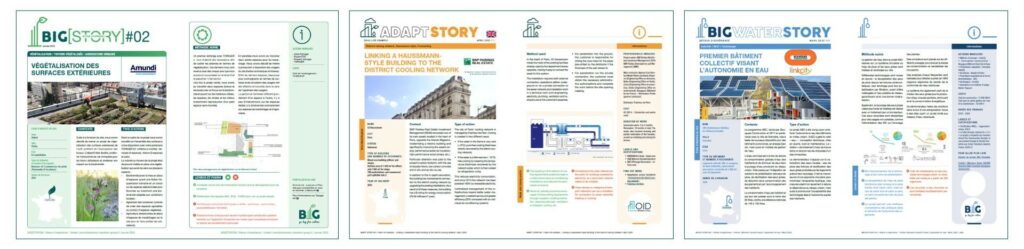
What does resilience look like in practice? Through its BIG Stories, ADAPT Stories and WATER Stories, OID shares experience from real estate projects addressing biodiversity, climate adaptation and water management issues. Now, a working group led by ESREI, OID’s European initiative, is collecting further examples across Europe—and inviting professionals to contribute.
Connecting an existing building to a district cooling network, transforming a school courtyard, greening different spaces on and around the building or creating shared spaces that strengthen social connections: resilience can take many shapes. For real estate stakeholders, understanding these approaches means looking beyond the solution itself. Why was it chosen? How was it implemented? What did it cost, and what helped the project?
For the last years, OID has published many case studies to make this practical knowledge available. Documenting real estate projects and the feedback of those involved, these publications help professionals explore possible solutions to implement, understand installation challenges and inform decisions for their own buildings and portfolios.
Three series, a shared purpose
OID’s case studies explore 3 complementary dimensions of resilience. BIG Stories, published as part of the Biodiversity Impulsion Group from OID, focus on biodiversity, ADAPT Stories on adaptation to climate change, and WATER Stories on water-related issues in real estate.
Each story follows the same principle: presenting a project alongside the information needed to understand its implementation. Context, costs, weak and strong points give a full picture, going into more details than a simple description of the measures implemented. A solution cannot be assessed independently of its setting, as an approach that is relevant to one building may need adjustments in another one. Understanding the specificities of one project helps identify what can be transferable, what requires further investigation and which questions to ask before taking action.
Together, the three collections of stories also encourage professionals to consider climate, biodiversity and water as interconnected issues that provide different entry points into a shared challenge: making buildings and their surroundings more resilient.
ADAPT Stories: different perspectives on adaptation
The ADAPT Stories illustrate the diversity of possible measures to adapt to climate change, from technical interventions to changes in outdoor spaces and the way buildings support their users.
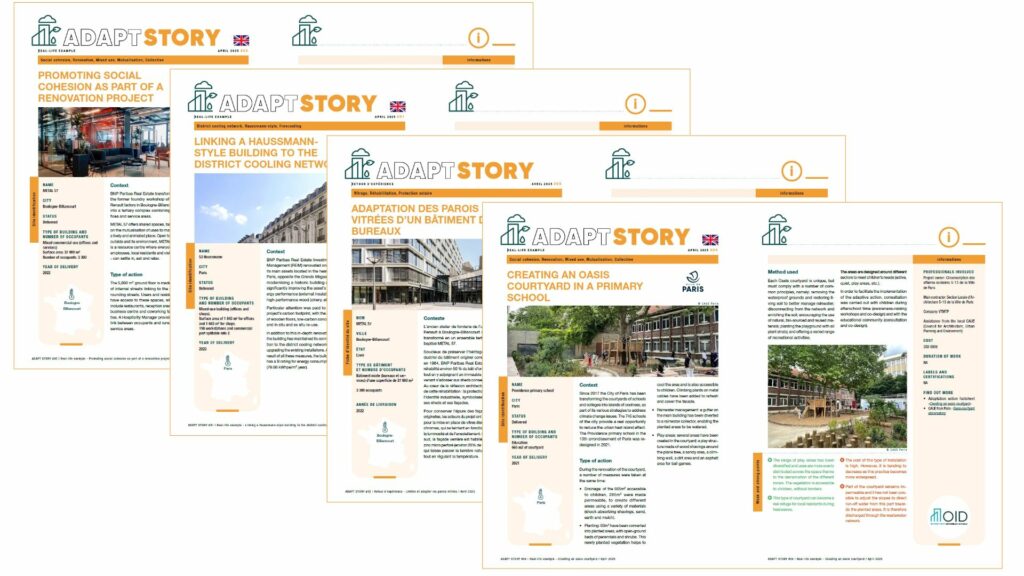
The first ADAPT Story gives an insight into the connection of a Haussmannian building in central Paris to a district cooling network. By documenting work on an existing property, it provides an example on how to address cooling needs within the constraints of an established, and historical, building.
A second focuses on adapting glazed surfaces through the use of electrochromic glazing. It offers an example of an intervention on the building envelope, adding another perspective to the range of measures available to real estate professionals.
A third presents the creation of an “oasis” courtyard in a City of Paris school. Although developed in an educational setting, the concept can be transferable in other building courtyards. It gives a view on how outdoor spaces can contribute to adaptation and resilience, for the building and its users.
The fourth presents how the promotion of social cohesion within a building can be a lever for resilience. Shared spaces, services, spatial organisation and the timing of activities offer ways to support interaction between users. This example broadens the discussion beyond physical or technical measures, bringing the social dimension of resilience into focus.
Together, these stories show why adaptation can benefit from a range of perspectives and approaches. They also demonstrate the value of sharing experience for different building types, as a specific project can raise useful questions for professionals working on another type of context or building.
Connecting practical experience with a wider range of solutions
The ADAPT Stories complement OID’s Guide to action for climate change adaptation, which helps real estate professionals to understand and implement adaptation strategies. This extensive guide brings together dozens of adaptive solutions and the essential information needed to consider their implementation on a building. This includes monitoring indicators, guidance to help prevent maladaptation and multiple type of solutions (Nature-based Solutions, technical solutions, interventions on network, or organizational and behavior changes), enriched by feedback from professionals from different backgrounds.
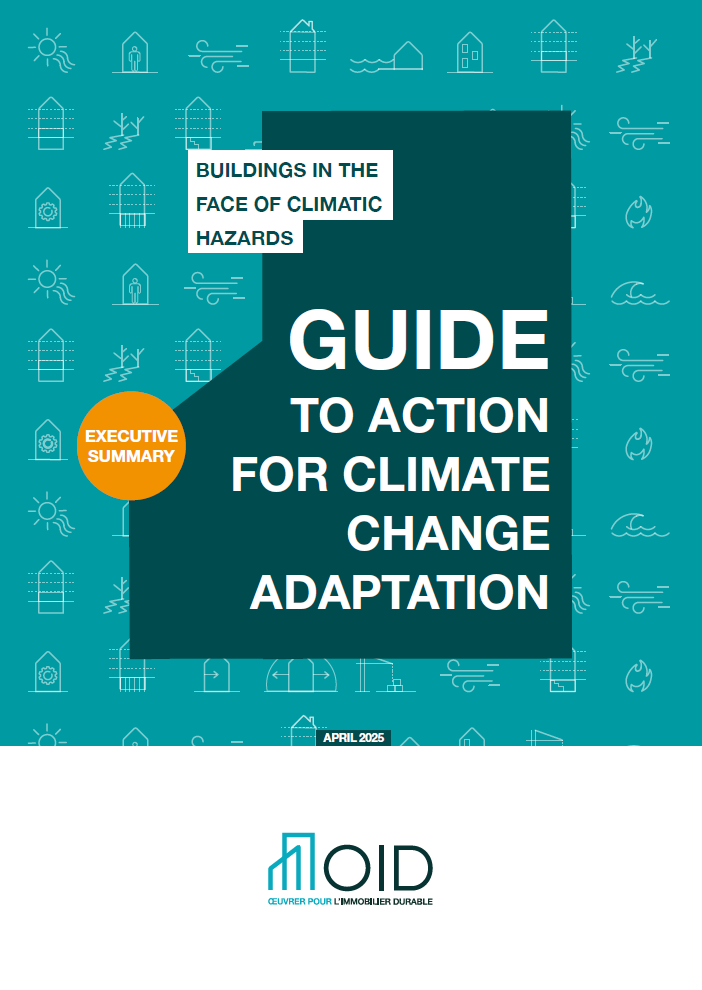
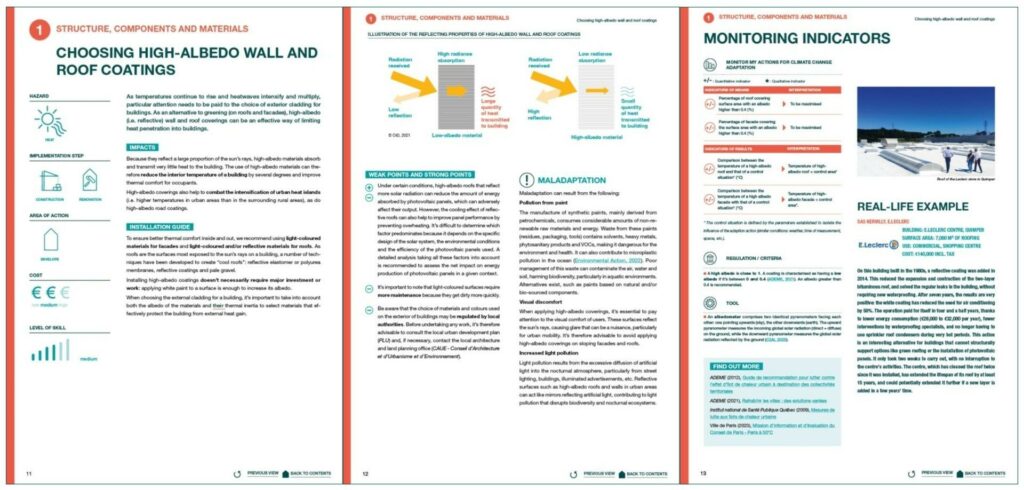
The guide and case studies serve complementary purposes. The guide helps real estate professionals explore possible actions; and the stories show how measures have been put into practice in specific projects. Moving between the two can help professionals connect strategic thinking with implementation.
Expanding the catalogue through European collaboration
To build on this work and to go further, ESREI is leading a working group until the first quarter of 2027, in collaboration with five ESREI members.
BNP Paribas Real Estate, OFI Invest, Sevaia, Socotec and Swiss Life AM are part of this working group aiming at collecting experience feedback from real estate projects across Europe that have implemented measures supporting building resilience.
By bringing further projects into the catalogue, the initiative aims to expand the practical examples available to the industry. Different locations, building contexts and implementation experiences can provide useful material for discussion and help professionals assess the relevance of approaches to their own activities. This work also creates an opportunity to strengthen exchanges within the European real estate community, using concrete projects as a starting point for shared learning.
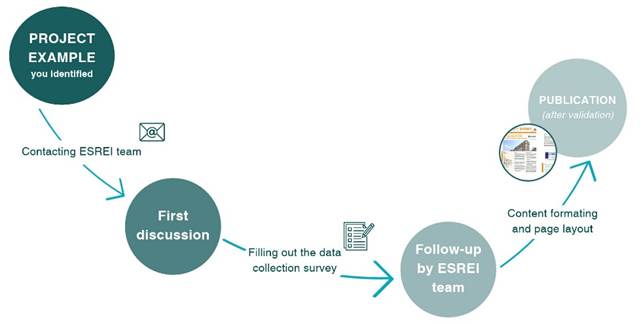
Have you implemented a project in Europe addressing climate adaptation, biodiversity or water management? ESREI invites you to share your experience. The value of a contribution lies in explaining the implementation process as well as the measures themselves. The project context, choices made, costs, barriers encountered and factors that enabled progress can all help other professionals make better-informed decisions.
By contributing, you can help extend a growing body of practical knowledge and support further exchanges on resilience in real estate. To propose a project or discuss a potential contribution, contact the ESREI team at esrei@o-immobilierdurable.fr.