Introduction
The Energy Performance of Buildings Directive (EPBD) is the main European regulatory framework steering the transformation of the building stock towards higher energy performance. Its objectives are both environmental and strategic: reducing greenhouse gas emissions, lowering energy consumption, and strengthening Europe’s energy sovereignty by reducing dependency on imported fossil fuels.
The EPBD works through successive iterations. The 2024 recast set a new direction for 2030, with stronger expectations for both new construction and the transformation of the existing building stock. This new version also places greater emphasis on renewable energy deployment, building automation and control systems, and sustainable mobility infrastructure.
Because the EPBD is a directive, its provisions must be transposed into the national regulatory frameworks of the different Member States. This is why the EPBD is returning to the forefront of European real estate news in late spring 2026: the deadline for transposition into national law was set for 29 May 2026. While several Member States may still be finalising the last details of their national frameworks, this is a timely moment to review the main expectations introduced by the recast directive.
New construction: from NZEB to ZEB
The EPBD relies on two main performance standards to define expectations for new buildings: Nearly Zero-Energy Buildings (NZEB) and Zero-Emission Buildings (ZEB).
A Nearly Zero-Energy Building (NZEB) is defined as a building with a very high energy performance, whose nearly zero or very low amount of energy required is covered to a very significant extent by energy from renewable sources, including renewable energy produced on-site or nearby.
A Zero-Emission Building (ZEB) is defined as a building with very high energy performance, requiring zero or a very low amount of energy, producing zero on-site carbon emissions from fossil fuels, and producing zero or a very low amount of operational greenhouse gas emissions.
These definitions establish a common European framework, but Member States remain responsible for specifying the precise performance levels and calculation methods in their national contexts.
The main timeline to monitor is the following:
| Date | Expected performance level | Buildings concerned |
| 2021 | NZEB level | All new buildings |
| 2024 | NZEB level | Major renovations |
| 2028 | ZEB level | New public buildings |
| 2030 | ZEB level | All new buildings and major renovations |
This shift from NZEB to ZEB marks a major regulatory transition. The objective is no longer only to drastically reduce energy needs, but also to phase out on-site carbon emissions from fossil fuels and minimise operational greenhouse gas emissions.
What to watch
Two elements will be particularly important when assessing national transposition:
– the energy performance levels that each country associates with the NZEB and ZEB standards;
– the definition of “major renovation” in each national framework, as this definition triggers several associated obligations.
Existing building stock: MEPS, EPCs and renovation passports
For the existing building stock, the EPBD requires Member States to establish Minimum Energy Performance Standards, commonly referred to as MEPS. These standards are designed to guide the renovation of the least efficient buildings and progressively improve the overall performance of national building stocks.
For non-residential buildings, Member States must set maximum energy performance thresholds ensuring that the stock performs better than:
- the 16% worst-performing non-residential buildings by 2030;
- the 26% worst-performing non-residential buildings by 2033.
For residential buildings, the approach is based on the reduction of average primary energy use across the national residential building stock. Member States must ensure a decrease of:
- at least 16% by 2030;
- between 20% and 22% by 2035.
These requirements are based on the state of the building stock in 2020 and must be translated into national trajectories. Their practical impact will therefore depend heavily on how each Member State defines thresholds, enforcement mechanisms and support measures.
Beyond MEPS, two other developments should be closely monitored.
First, the EPBD aims to further harmonise Energy Performance Certificate scales across Europe. This could lead to changes in EPC thresholds in some countries, especially in Member States where the rating system currently includes several subcategories within the same grade, such as A++++, A+++, A++ or A+. However, EPC scales are politically sensitive, and substantial changes remain uncertain in several national contexts.
Second, the directive introduces the deployment of renovation passports. These passports are defined as tailored roadmaps for the deep renovation of a specific building in a maximum number of steps, with the objective of significantly improving its energy performance. They are intended to support staged deep renovations, targeting NZEB levels before 2030 and ZEB levels after that date.
Renovation passports could become a key operational tool for asset owners, investors and property managers. They can help structure renovation pathways over time, prioritise actions, and align capital expenditure planning with long-term regulatory expectations.
What to watch
The key point will be how each Member State defines and implements MEPS, and which tools are introduced to guide the building stock towards these targets. This includes the articulation between MEPS, EPC reforms, renovation passports, financial incentives and possible restrictions on the least efficient assets.
Building Automation and Control Systems
The EPBD also strengthens expectations regarding Building Automation and Control Systems, or BACS. These systems are designed to monitor, control and optimise the operation of technical building systems, including heating, cooling, ventilation, lighting and other energy-related equipment.
Under the revised framework, non-residential buildings with an effective rated output above 70 kW will be expected to deploy BACS by 2030. This extends an obligation that already applied to larger non-residential buildings with systems above 290 kW.
This provision is particularly important because energy performance is not only determined by the quality of the building envelope or the efficiency of equipment. It also depends on how buildings are operated on a day-to-day basis. BACS can contribute to reducing energy consumption, improving comfort, identifying anomalies and supporting more dynamic energy management.
For real estate owners and managers, this means that technical audits, system sizing, metering strategies and digital monitoring tools will become increasingly central to compliance and operational performance.
What to watch
The main issue will be the alignment of national regulations with the EPBD requirements. In particular, stakeholders should monitor how each country defines and calculates the relevant installed or rated power threshold, as this will determine which buildings fall within the scope of the obligation.
Renewable energy and sustainable mobility
The EPBD also introduces stronger expectations regarding renewable energy deployment, especially solar energy. Article 10(3) states that Member States must ensure the deployment of suitable solar energy installations, where technically suitable and economically and functionally feasible, on different categories of buildings.
The indicative deployment calendar is as follows:
| Building type | Buildings concerned | Useful floor area threshold | Deadline |
| New buildings | New public and non-residential buildings | More than 250 m² | 31 December 2026 |
| New buildings | New residential buildings | All | 31 December 2029 |
| New buildings | New covered car parks physically adjacent to buildings | All | 31 December 2029 |
| Existing buildings | Existing public buildings | More than 2,000 m² | 31 December 2027 |
| Existing buildings | Existing public buildings | More than 750 m² | 31 December 2028 |
| Existing buildings | Existing public buildings | More than 250 m² | 31 December 2030 |
| Existing buildings | Existing non-residential buildings undergoing certain actions requiring an administrative permit | More than 500 m² | 31 December 2027 |
This provision could have significant implications for asset strategies, especially for large public buildings, commercial assets and non-residential buildings undergoing major works. It also requires asset owners to assess the technical feasibility of solar installations, the usable roof area, grid connection conditions and potential interactions with other uses of the roof, such as biodiversity, cooling equipment, water retention or accessible outdoor spaces.
What to watch
Several elements will require close attention at national level:
– the definition of roof area and usable surface;
– the share of the roof that will effectively be subject to solar deployment requirements;
– the alignment of Member States with the European calendar;
– the national definition of major renovation or relevant administrative-permit triggers.
The EPBD also sets detailed guidelines for sustainable mobility infrastructure in and around buildings. These provisions cover pre-cabling, ducting infrastructure, recharging points and bicycle parking spaces.
For new buildings and buildings undergoing major renovation, the obligations vary depending on the building type and the number of parking spaces. In simplified terms, the directive seeks to ensure that buildings are progressively equipped to support electric mobility while also strengthening bicycle infrastructure.
For a 20-space car park, the implications would vary by typology:
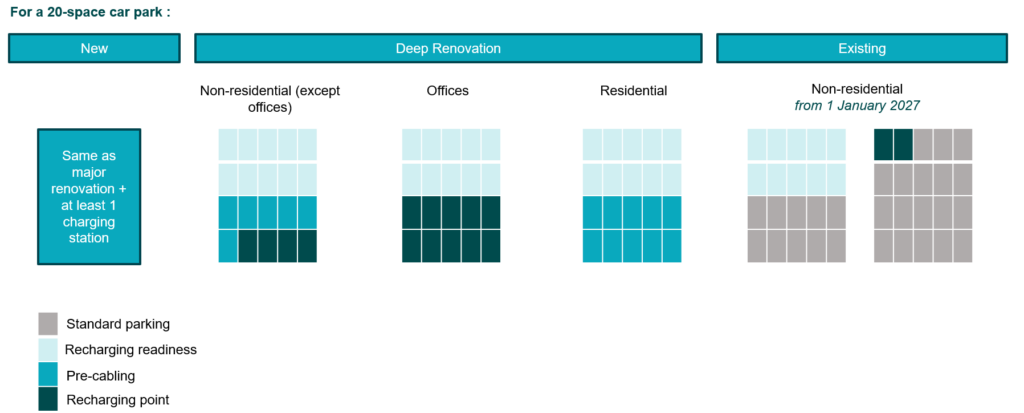
Fig.1 : Example of application of green mobility expectations of EPBD for a 20-space car park (@OID)
The practical implications will depend on the precise national wording, but the direction of travel is clear: parking areas are becoming part of the decarbonisation strategy for buildings.
What to watch
The main point to monitor will be how Member States align their national frameworks with the EPBD requirements, particularly regarding the number of recharging points, pre-cabling obligations, ducting infrastructure and bicycle parking capacity.
Conclusion
The EPBD recast redefines expectations for buildings across the European Union. It reinforces the role of the building sector in delivering climate objectives, reducing energy consumption and supporting energy sovereignty. It also moves the regulatory framework towards a more integrated vision of performance, combining energy efficiency, renewable energy production, automation, renovation planning and sustainable mobility.
In most Member States, national regulations are currently being adjusted to complete the alignment of domestic frameworks with the new European requirements. The coming months will therefore be decisive for understanding how the directive will translate into operational obligations for asset owners, investors, developers and property managers.
ESREI will continue its monitoring efforts throughout this period in order to track these regulatory developments and provide a clear, practical reading of national requirements as they emerge.