On May 19th, the European Sustainable Real Estate Initiative hosted its yearly international conference. As the sector navigates ESG backlash, regulatory simplification, and an increasingly uncertain market environment, the event brought together leading experts, investors, and practitioners to discuss how sustainability strategies are evolving across Europe.
Sustainability, a long-time value driver
Welcoming the audience, Marie Andrieux, Head of ESREI, and Juliette Lefébure, CEO of OID, took the time to set the context for the event and highlight its ambition. The room brought together participants from across Europe, serving as an ideal reminder that, over the past 20 years, sustainability has moved from a niche concept to a cornerstone in assessing value, regulatory compliance, resilience, and the extent to which sector practices have evolved.
Although ESG has faced a degree of backlash in recent years, this has not altered the increasing materiality of climate challenges for real estate. Physical and transition climate risks are indeed becoming major metrics in the way value, compliance, and resilience are assessed. Rising above the turmoil of day-to-day ESG debates to offer a clear pathway is the mission of organisations such as the Green Building Observatory (OID – Observatoire de l’Immobilier Durable). As Juliette Lefébure reminded the audience, in this turbulent context, OID aims to help “real estate actors turn complexity into clarity, and ambitions into actions”.
This motto sounds even more relevant when bringing a real estate strategy to an international scale, which is why ESREI was created: to provide a knowledge hub and a network to better cope with climate challenges at the European level.
OID was very pleased to welcome people and organisations sharing this perspective on Tuesday 19th May, to discuss how to shape the sustainability of European real estate, “not as a burden, but as a long-term value driver”.
Real estate, the epicentre of the climate crisis
The conference started with a keynote from Ji-Soo Yoon, who shared insights from the OECD — the Organisation for Economic Co-operation and Development — on the matter. The policy analyst emphasised the urgency of climate risks for the real estate sector.
By 2030, one in 25 properties in Australia will be classified as uninsurable — and this is “not an outlier, but a preview”. Across the 38 member countries of the organisation, the cost of insured losses has been accelerating, heading in a dangerous direction. The spectrum of climate hazards is widening: drought-affected land doubled globally between 1990 and 2020.
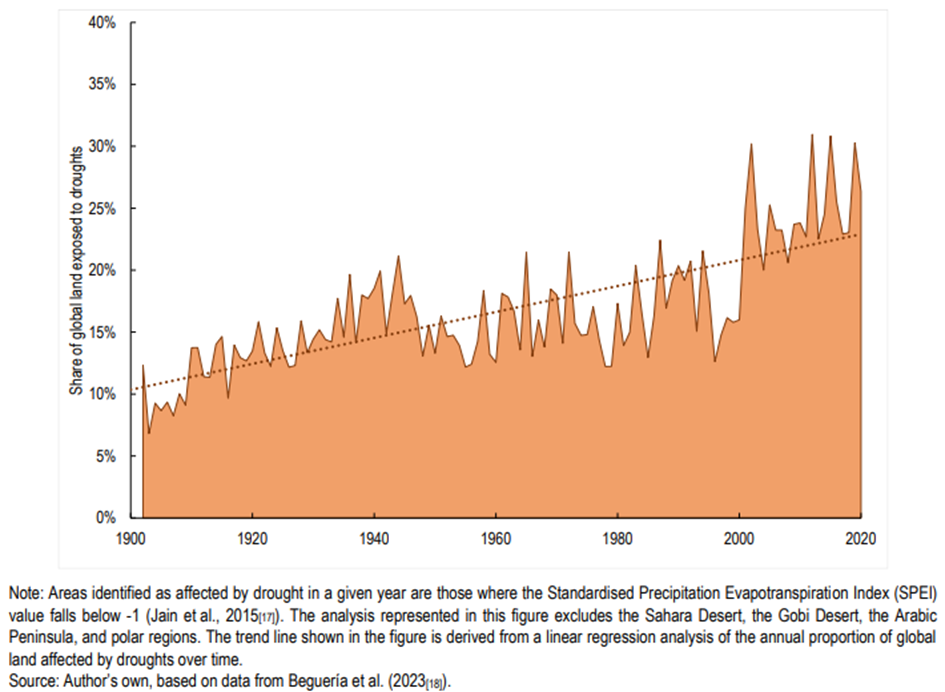
Fig. n°1: Share of global land area affected by droughts (1900-2020)
However, the real estate sector plays a pivotal role in the global economy. Because real estate assets are, by their very nature, long-lived, the sector is uniquely exposed. Real estate is also highly capital-intensive; for most households, a home is the largest financial commitment of their lives. This means that if its value falls, the consequences can ripple throughout the financial system. Real estate sits at the tipping point of the climate crisis — and it cannot be allowed to fail.
Rising to the task: the financing challenge
Tackling this challenge obviously requires a substantial financing effort, involving significant capital and operational expenditures for real estate actors. These CAPEX and OPEX adjustments remain difficult to assess, as their return on investment can be hard to estimate.
According to Aytor Naranjo from Swiss Re, there are several ways to encourage investment in the adaptation and resilience of our building stock. The first step may be to highlight that adaptation is not only a cost: it can reduce future maintenance costs, insurance pressure, liquidity risk, and potential asset depreciation.
Models are emerging to assess these future costs, and while they have not yet reached full maturity, Bruno Blavier from Swiss Life Asset Management reminded the audience that “perfect data” should not be a prerequisite for action. In this regard, the valid threshold is whether or not the data is robust enough to support decision-making. Only this proactive attitude will help avoid rising costs of inaction.
Finally, one of the conditions for scaling up these ambitions is to establish a relationship of trust between public and private investment, especially at the local level. Katya Guryeva from C40 Cities underlined that city-scale adaptation strategies can help protect asset value, but real estate stakeholders must also contribute to collective resilience.
The role of regulation, and its limits
One of the main tools to enhance transparency around climate-related risks and implement a trusted framework for public-private partnerships is regulation. Focusing on the French context, OID experts Roméo Juge and Juliette Daire showed that regulation has driven the real estate sector towards a level of progress on sustainability issues that has not yet been matched across all sectors of the economy over the past five to ten years.
However, this progress remains too slow to meet long-term regulatory expectations and address growing physical climate challenges. To date, only 4% of the French offices are aligned with the 1.5°C CRREM 2040 targets: there is still work to do.
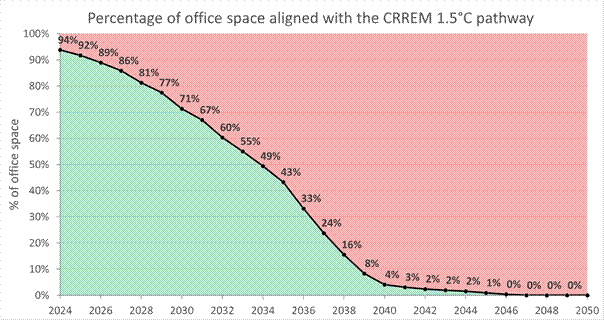
Fig. 2: Percentage of office space aligned with the CRREM 1.5°C pathway
To further encourage and accelerate collective progress, comparable — even if imperfect — data is essential, as it enables benchmarking and fosters structural emulation across the market. This is the intent behind some of OID’s structural work, such as the Energy Performance Barometer, based on actual data regarding energy, waste, and water consumption.
Collective action: the basis of collective progress
To guarantee a transition throughout the industry, it is essential to make sure that everyone speaks the same language. Some voluntary initiatives have taken on this mission, building a common framework to enable globally comparable progress.
“Peer pressure is our job,” said Mathilde Petriat from GRESB provocatively — and for good reason. Building a common language is the mission that GRESB has been carrying out for 15 years now.
Yet this effort is constantly being challenged. Sebastian Leutner from the CRREM Foundation explained that building an international tool means relying on “easy” and comparable metrics. Yet this also means leaving aside certain nuances of climate-related challenges and therefore being exposed to criticism.
These initiatives are constantly seeking the right balance between a globally comparable and time-robust tool, and the need to adapt in order to align with the sector’s rising ambitions. Concretely, Mathilde Petriat explained how GRESB had initiated four shifts, which should not harm the comparability of the tool but should allow for more thematic analysis and different timeframes, for instance. GRESB also intends to retire some indicators that are no longer relevant and further develop its methodology at asset level.
Finally, collective initiatives are also the right framework for building the tools of tomorrow. In this regard, Aleksandra Smith-Kozlowska from ULI Europe explained how ULI was deploying a collective intelligence effort to develop PRESERVE, an operational tool dedicated to integrating transition risks into the discounted cash flows of real estate operations, while allowing users to set their own level of risk appetite or climate anticipation.
These efforts, which transform ESG into long-term value, can only be carried out at a collective scale: relevance and acceptance from the majority of market players are defining parameters of their success.
The ESREI conference was a valuable opportunity to gather, celebrate, and boost these deeply necessary collective efforts. At the European scale, cooperation stands out as a crucial condition for sustainable real estate.