The Belgian Green Building Council (BGBC) was founded in March 2025 and is a Belgian non-profit organisation (asbl/vzw) that represents a growing coalition of stakeholders spanning the entire construction and real estate value chain. Our members include banks, material producers, manufacturers, architects, engineers, developers, contractors, asset managers and academics.
BGBC’s mission is to accelerate the transition towards a resilient and future-proof Belgian building ecosystem through collaboration, knowledge sharing and constructive dialogue with institutional partners across the three Belgian regions (Flanders, Wallonia and Brussels) in coordination with other European nations from the World Green Building Council.

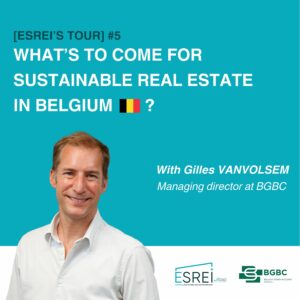
Gilles VANVOLSEM, Managing Director of BGBC:
Gilles Vanvolsem is the Managing Director of the Belgian Green Building Council (BGBC), where he oversees the organisation’s day-to-day operations.
With a background in international cooperation, Gilles has built extensive experience in associative organisations and consulting. Over the past fifteen years, he has worked as a sustainability consultant for Belgian companies, with a particular focus on the real estate sector at both Belgian and European levels.
How do you picture the sustainability landscape for real estate in your country? What aspects of ESG dynamics are currently the most integrated? Conversely, which aspects remain the least integrated?
Like in some other European countries, the national built environment of Belgium is ageing, with a very low renovation rate, and represents a large share of national greenhouse gas emissions, drawing attention to energy challenges in particular (the issue the most focused on by the government).
One of the specificities in Belgium lies in the regional regulations between the 3 regions: Brussels, Wallonia and Flanders. The country therefore knows different paces regarding the transition of the building sector. In Flanders for example, regulations are really demanding regarding renovation requirements during transaction. On another topic, the Brussels region consists mainly of Brussels city, with many non-residential buildings with very high ESG performance, mostly led by the presence of European institutions that push these topics forward for exemplarity purposes. Existing buildings are still a challenge there, with grants and subsidies that have been subject to fluctuations (a long period of almost 2 years with no government in the Brussels region stalled most of the dynamics on the matter, for example regarding rent indexation on the PEB for Performance Energétique du Bâtiment, the Belgian Energy Performance Certificates). Wallonia have also experienced some variations (for “green certificates” for example). These past policy changes, along with the existing regional differences, can contribute to some caution among investors and households when engaging in sustainability-related projects. In this complex landscape, BGBC aims to provide a neutral platform to align stakeholders and bring greater clarity and consistency across regions.
One of the main challenges in Belgium is to find a balance between sustainable and affordable, as the housing crisis is also present in the country. Regulatory fragmentation across regions also makes it difficult to manage these strategies.
The country is very densely built and populated, and the challenge is to minimise the soil artificialisation and therefore to promote the renovation of existing (ageing) buildings as much as possible, whilst also reusing contaminated sites. For example, there is an area in the south of the country with heavy past industrial activity (such as steel production) that now needs to be decontaminated and rehabilitated. On the other side, the issue of water management in the north of the country is quite problematic (particularly nitrate concentrations, as in the Netherlands). Because of this, and due to the density of development in the northern region, there are even discussions underway about completely stopping land development and artificialisation.
Some progress has been made (though not harmonised across the 3 regions) for waste management and on circular economy issues, with initiatives at regional government level. There is a coordination of voluntary and regulatory measures. For example, a tool is in place to monitor wastes and recycling efforts.
What are the key regulatory deadlines or developments in 2026 that you are monitoring in relation to sustainable real estate in your country?
The agenda on the revised EPB Directive
There is an ongoing recast of the existing PEB system (Belgian Energy Performance Certificates). With the regional organisation of the country, the energy scales of the PEB are divergent, making the comparison as difficult as if there were from 3 different countries. This part of the European EPBD is being implemented right now, but there will still be 3 different systems in the end.
When it comes to embodied carbon, Belgium has been something of a pioneer, particularly with the Totem tool, developed since 2011 as a joint initiative of the 3 regions and a good example of cooperation between government bodies and academia. Totem enables the calculation of a building’s life cycle assessment based on Belgian products and materials, taking embodied carbon into account, whilst also providing a more comprehensive environmental score (covering aspects such as biodiversity and social impacts). For the time being, its use is voluntary, but there are discussions about making it mandatory due to its inclusion in the PEB. However, this is being questioned in light of the tool’s current maturity, its interoperability with other tools, and the completeness of the database (which is currently too general as the materials databases are managed at regional level).
As for the national roadmap required under the EPBD, there will ultimately be 3 roadmaps. Wallonia has already submitted its roadmap to the European Union, but the other 2 regions have not yet done so. On this matter, the BGBC actively contributes to this process by bringing market feedback and advocating for greater harmonisation and comparability between regions.
Renovation/demolition
There is currently a tax incentive for renovation, with VAT at 21% on new builds and 6% on renovations. Discussions are currently underway regarding the inclusion of sustainability criteria to qualify for the 6% rate on demolition/reconstruction. A rate of 6% would only be applied if the final building meets sustainability criteria (which have not yet been defined).
What are the key voluntary deadlines or developments in 2026 that you are monitoring in relation to sustainable real estate in your country?
The Belgian market is quite dynamic. Although the country is small, many companies are positioning themselves on sustainability issues, with plenty of examples of innovative projects and research centers and universities also working on the issue. However, these initiatives are driven primarily by voluntary action (unlike in countries such as France, where regulations are stricter). The landscape of organisations and industry groups is quite dense, but it is difficult to get an overall picture. At national level, there are professional federations (such as the construction federation, the property federation and the Institute of Architects). There are also initiatives (consortia) set up in response to European calls for proposals, which may be of limited duration in view of the structure of these European grants. So, for the moment, the ESG and sustainability transition can be less structured than elsewhere, but it is still very active. This fragmentation reinforces the need for a common language and coordinated approaches — which BGBC aims to facilitate.
Could you outline the main elements of your events and publications calendar for 2026?
In line with its member-driven approach, BGBC has identified eight task forces, selected by members as priority areas for the next phase of work:
1) Rollout and adoption of the EU Taxonomy Guidance for buildings in Belgium.
2) Rollout and adoption of climate risk assessment framework.
3) Regarding the EPBD national implementation, the BGBC contribution is made based on discussions with its members, that can participate directly in the discussions when possible. In this regard, the BGBC contributes to the harmonization of energy performance (EPB) and LCA methodologies by providing concrete, market-based solutions and policy recommendations.
The BGBC publishes notes and responses to Belgian and EU authorities.
4) Integration of sustainability into valuation models by developing a common methodology.
5) Innovative financing models for renovation: exploration of scalable and accessible financing mechanisms to accelerate the renovation of Belgium’s existing building stock, supporting the national renovation wave while improving affordability for property owners and co-owners.
6) Data consolidation and national benchmarking: structuring key performance indicators – including EPB, actual energy consumption, carbon metrics, and climate adaptation indicators – into a coherent national benchmark framework. Such a reference system is essential to enable comparability, support evidence-based investment decisions, and monitor the evolution of the building stock.
7) Industrialisation of circular and reuse solutions: acceleration of circular construction practices by fostering alignment on methodologies, identifying regulatory bottlenecks, and supporting the development of scalable, industry-grade market approaches.
Finally, in your opinion, what are the key trends likely to shape the real estate sector in the coming years?
There are three main areas in which we can drastically improve building sustainability on an environmental perspective:
1) by focusing on designing buildings that are simple and sufficient (they need to be easy to operate and maintain and avoid over-engineering).
2) by reusing existing sites, structures, components, and materials on an industrial scale to drastically cut embodied carbon. The most sustainable square meter is the one we don’t build.
3) by measuring and mitigating the risks related to climate change (mostly flood and overheating) and the impact on biodiversity
The Belgian Green Building Council believes that this transition is primarily a matter of governance, data quality and behavioural change, rather than a technological challenge. Ultimately, progress will come from collaboration: aligning financiers, designers, builders, and policymakers under one common and coherent vision — exactly what the Belgian Green Building Council aims to facilitate at a national level, especially in a country where regional differences can be substantial.
The ESREI programme is now sponsored by Advenis REIM, BNP Paribas Real Estate, JLL, La Caisse, La Francaise, OFI Invest, Pimco Prime Real Estate, Praemia REIM, Sevaia, SwissLife AM and Tikehau Capital.